
Sunday, August 29, 2010
I'm Moving to WordPress
I'm really excited to tell you that I've decided to move this blog to WordPress. You can find the new URL here. Thanks to Paul Adams for all the help he gave to help me make the transition. I've got a little more tweaking to do but I'm very happy with the results. Also, thanks to Jeff from Scripture Zealot for the final push to make the move. If you're a follower of this blog you'll need to make the changes to your system with the new URL. This blog will remain up till the end of November. I hope you'll all join me at my new location.
Saturday, August 28, 2010
Have You Heard of the 17:18 Series?
A friend of mine at Reformation Heritage Books recently gave me a copy of something new called a "Journible." It is part of the "17:18 Series" which is based off of the verse in Deuteronomy 17 where the king is commanded to write out a copy of the law. Each Journible is a blank journal with space to write out a book of the Bible. I chose the Gospel of John. I would have picked the Gospel of Mark but it is not available yet (no, not because it's smaller than John but because that's where my interest has been recently).
How do you use it? Here's how the catalog describes it
To date the only books available are: The Gospel of John, Romans, Proverbs, 1 Timothy - Hebrews (together in one volume) and Galatians, Ephesians, Philippians, Colossians, 1 and 2 Thessalonians (together in one volume). They retail for only $13.00.
These would make great gifts when completed to hand down to your children or grandchildren as they read through these books and see what their parent or grandparent thought as they went through the book. This could also be used in a small group to enhance whatever study guide they might be using.

How do you use it? Here's how the catalog describes it
"Each book is organized so that you can write out your very own copy of Scripture. You will be writing the Bible text only on the right hand page of the book. This should make for easier writing and also allows ample space on the left page to write your own notes and comments. From time to time a question or word will be lightly printed on the left page; these questions are to aid in further study, but should not interfere with your own notes and comments."Writing out Scripture forces you to slow down and read the text carefully. I'm looking forward to the "journey."
To date the only books available are: The Gospel of John, Romans, Proverbs, 1 Timothy - Hebrews (together in one volume) and Galatians, Ephesians, Philippians, Colossians, 1 and 2 Thessalonians (together in one volume). They retail for only $13.00.
These would make great gifts when completed to hand down to your children or grandchildren as they read through these books and see what their parent or grandparent thought as they went through the book. This could also be used in a small group to enhance whatever study guide they might be using.

Law vs. Gospel: What's the Distinction?
A number of years ago I did a book table for a group of Lutheran pastors. I had the pleasure of sharing a table with some of them over dinner and was just sitting back and enjoying the conversation. Rick Warren’s The Purpose Drive Life was reaching its peak in sales and came up in one of the discussions. I remember one of the pastors leaning over to another pastor and said “I’m surprised how many of my fellow Lutheran pastors are doing this. Don’t they realize that it’s all just law?” I had no idea what he was talking about. I remember thinking, “What “law”? I don’t remember reading about any law in the book. Were we even talking about the same book?” I was completely lost. Since then I’ve read a bit more on the distinction between law and gospel which is common to Lutheran and reformed circles. The September/October 2010 issue of Modern Reformation is dedicated to the distinction between law and gospel. Michael Horton quotes Theodore Beza with full acceptance saying “ignorance of this distinction between Law and Gospel is one of the principle sources of the abuses which corrupted and still corrupt Christianity.” (12) Horton notes that in recent years people have said it is just a Lutheran axiom. But, he says, they are wrong because they have misunderstood the point. The distinction was held by Calvin, Beza, Knox and Cranmer and many other reformers as well. In an article by Sean Norris, “An Introduction to the Law and the Gospel” he talks about what his Christian life was like prior to his understanding this important distinction:
Just when I’m starting to warm up to this and say, “Amen brother, you preach it and I’ll turn the pages” I find that one of my favorite reformed writers, John Frame, does not like the distinction. He observes that the gospel includes law and law includes gospel. He says,
As I continue to read the magazine I find an article by Brian Thomas on the Sermon on the Mount. He quotes David Scaer's book The Sermon on the Mount:
“My faith was dependent on my experience and emotions, which meant that I really had to work hard to keep the experience going. It was important to feel close to the Lord at all times because that was the primary indicator of a good relationship with him. What did that look like? The usual: experiencing an intimate time of worship (warm fuzzy feelings or being brought to tears), a regular quiet time (reading the Bible), journaling, and so on. This outward show was extended to abstaining from the usual vices: swearing, gossiping, making fun of people, envying, lusting, and on, and on, and on. This was a depressing and scary way to live because I was never successful.” (8)But then he learned of the distinction between Law and Gospel. In essence, the Law is simply the rules. The Law contains the demands of God and a continual diet of nothing but law leads a person to think “If I can just change my behavior, then I will change who I am.” But Norris says “The law is not the tool we use to get better because we can never use it to improve ourselves; this was never its function.” We may try but we don’t even come close. The good news is that the law is not ours to fulfill rather it is for Jesus to fulfill. The Gospel is the good news of what Christ has done for us. What difference does this make in our Christian life? Norris says,
“our relationship with God does not depend on us; rather, it rests solely on the completed work of Jesus Christ at the cross. When we understand this about our relationship, the result is that we can rest. We can finally have peace. Our efforts to preserve a relationship with God can stop. Our motivations for our study of the Bible, prayer, and worship can come not out of fear of punishment or separation from God but out of joy of security in God’s faithfulness to us shown in his Son, Jesus, so that we are inspired to grateful living.” (11)He says, “Considering both the law and gospel kills the notion that the Bible is a manual for living—a view commonly held today. If the Bible were such a manual, Christianity would be all about what we do. Instead, the Bible is God’s active Word in our lives.” (10)
Just when I’m starting to warm up to this and say, “Amen brother, you preach it and I’ll turn the pages” I find that one of my favorite reformed writers, John Frame, does not like the distinction. He observes that the gospel includes law and law includes gospel. He says,
“So the definitions that sharply separate law and gospel break down on careful analysis. In both law and gospel, God proclaims his saving work and demands that his people respond by obeying his commands. Law and gospel differ in emphasis, but they overlap and intersect. They present the whole Word of God from different perspectives. Indeed, we can say that our Bible as a whole is both law (because as a whole it speaks with divine authority and requires belief) and gospel (because as a whole it is good news to fallen creatures). Each concept is meaningless apart from the other. Each implies the other.” (The Doctrine of the Christian Life, p. 187)Norris quotes C. F. W. Walther’s book The Proper Distinction between Law and Gospel which said “the Gospel contains no demand, only the gift of God’s grace and truth in Christ.” (10) But Frame points out that Scripture says people must “obey the gospel” (2 Thess. 1:8; 1 Pet. 4:17) and that the “gospel itself requires a certain kind of conduct (Acts 14:15; Gal. 2:14; Phil. 1:27; cf. Rom. 2:16). (185) That would seem to imply some kind of "demand" to my thinking.
As I continue to read the magazine I find an article by Brian Thomas on the Sermon on the Mount. He quotes David Scaer's book The Sermon on the Mount:
"The message of the Sermon is not a demand, driving the Christian to an impossible moral perfection, but it comes to the Christian as a demand fulfilled already in Christ and which is now made possible for believers, since it has first reached its demands in Christ." (35)But most enlightening are a series of sidebars with selections from The Word of God and Preaching by Cornelis Veenhof (1902 - 1983) who was a professor and pastor in the Dutch Separated Reformed Church. The excerpts are translated by Nelson D. Kloosterman. Here I found some careful nuancing that I think Frame would be very comfortable with. Here's a couple of examples:
"Gospel and law are two aspects of the one, indivisible Word of God." (30)
"Moreover, gospel and law are intimately united. One could say that from start to finish every gospel-word is also law-word. For the gospel as such is always a passionate summons to faith." (34)
"Law and gospel proceed simultaneously from God's mouth, so that as a result the law can be heard, understood and believed in no other way than in its unbreakable unity with the gospel. Especially the demand of faith presupposes the gospel and its proclamation. To be sure, this demand is embodied in and flows out of the gospel and as a consequence can be heard and obeyed in no other way than in and with the gospel." (36)
"Finally, we must mention that talking about 'gospel and law' entails a serious danger. The unintentional consequence of this way of talking is that the evangelical and law aspects of God's Word are still viewed as two independent entities that must be brought together and held in balance." (36)
"At the same time Paul insists with great emphasis that the gospel is preached in order to be obeyed (2 Thess. 1:8). In this connection he speaks of the faith of the gospel (Phil. 1:27). By that he means that the gospel's purpose is faith, to push for a decision of faith, and conversely, that faith is totally and completely directed toward the gospel. . . One can similarly disobey the gospel (Rom. 10:16). For those who are disobedient--they are those who are perishing--the gospel is veiled." (40)The issue fascinates me. If you have any suggested readings I would love to hear about them.
Friday, August 27, 2010
Annual Used Book Sale - August 31 - September 11, 2010
Our annual used book sale is quickly approaching. From August 31 - September 11 all used books will be 30% off. You don't want to miss it. With more than 90,000 volumes in stock we might just have that book you've been looking for. If you call be sure to mention the sale in order to get the discount. Our toll free number is 1-866-241-6733.


Thursday, August 26, 2010
In Store Now - A Place for Truth
I've been reading bits and pieces of a new book from IVP called A Place for Truth edited by Dallas Willard and it is very good. Here's the catalog description:
Here's the table of contents:
Foreword By Harry Lewis, Harvard University
Preface By Daniel Cho, Executive Director, The Veritas Forum
Introduction By Dallas Willard
Truth
1 Is There Life After Truth?
Richard John Neuhaus
2 Time For Truth
Os Guinness
3 Reason for God: The Exclusivity of Truth
Timothy J. Keller
Faith and Science
4 The Language of God: A Scientist Presents Evidence for Belief
Francis S. Collins
5 The New Atheists and the Meaning of Life
Alister McGrath and David J. Helfand
6 A Scientist Who Looked and Was Found
Hugh Ross
Atheism
7 The Psychology of Atheism
Paul C. Vitz
8 Nietzsche Versus Jesus Christ
Dallas Willard
Meaning and Humanity
9 Moral Mammals: Does Atheism or Theism Provide the Best Foundation for Human Worth and Morality?
Peter Singer and John Hare
10 Living Machines: Can Robots Become Human?
Rodney Brooks and Rosalind Picard
11 The Sense of an Ending
Jeremy S. Begbie
Christian Worldview
12 Simply Christian
N. T. Wright
Social Justice
13 Why Human Rights Are Impossible Without Religion
John Warwick Montgomery
15 Radical Marxist, Radical Womanist, Radical Love: What Mother Teresa Taught Me about Social Justice
Mary Poplin
15 The Whole Gospel for the Whole Person
Ronald J. Sider
The book is a paperback with 323 pages and sells for $20.00.

Many today pursue knowledge and even wisdom. But what about truth? In an age that disputes whether truth can be universalized beyond one's own personal experience, it seems quaint to speak of finding truth. But whether in the ivory towers of the academy or in the midst of our everyday lives, we continue to seek after the true, the beautiful and the good.
Since its founding at Harvard in 1992, The Veritas Forum has provided a place for the university world to explore the deepest questions of truth and life. What does it mean to be human? Does history have a purpose? Is life meaningful? Can rational people believe in God? Now gathered in one volume are some of The Veritas Forum's most notable presentations, with contributions from Francis Collins, Tim Keller, N. T. Wright, Mary Poplin and more. Volume editor Dallas Willard introduces each presentation, highlighting its significance and putting it in context for us today. Also included are selected question and answer sessions with the speakers from the original forum experiences.
Come eavesdrop on some of today's leading Christian thinkers and their dialogue partners. And consider how truth might find a place in your own life.I enjoyed this snippet from the life of Os Guiness
When I was a student, my own field was the social sciences, but as an undergraduate one of the things I was very interested in was philosophy. And back in the early 1960s, the influence of the Vienna Circle and logical positivism was still enormously powerful in the British universities, particularly the thought of A. J. Ayer, who extolled the verification principle: we have to judge types of claims. Analytical claims, for instance, 'All bachelors are male,' were accepted automatically because the end of the conclusion was written into the assumption. But other claims had to be verified through the five senses, or they were dismissed as nonsense. . . those who know philosophy know well what happened. His verification principle itself could not be verified through the five senses. In other words, the principle itself was nonsense!
Years later, when I was at Oxford and A. J. had retired, I found myself on the train with him for an hour one day. We were chatting over his life, and he said to me, 'That whole verification principle of skepticism was a blind alley.' Then he said, 'Any debunker ought to be force in public to wield his own debunking sword over his own cherished beliefs.
That's exactly right. He wielded a sword and wiped out all sorts of things. And then someone returned the favor, and his principle collapsed overnight." (50)Beautiful!
Here's the table of contents:
Foreword By Harry Lewis, Harvard University
Preface By Daniel Cho, Executive Director, The Veritas Forum
Introduction By Dallas Willard
Truth
1 Is There Life After Truth?
Richard John Neuhaus
2 Time For Truth
Os Guinness
3 Reason for God: The Exclusivity of Truth
Timothy J. Keller
Faith and Science
4 The Language of God: A Scientist Presents Evidence for Belief
Francis S. Collins
5 The New Atheists and the Meaning of Life
Alister McGrath and David J. Helfand
6 A Scientist Who Looked and Was Found
Hugh Ross
Atheism
7 The Psychology of Atheism
Paul C. Vitz
8 Nietzsche Versus Jesus Christ
Dallas Willard
Meaning and Humanity
9 Moral Mammals: Does Atheism or Theism Provide the Best Foundation for Human Worth and Morality?
Peter Singer and John Hare
10 Living Machines: Can Robots Become Human?
Rodney Brooks and Rosalind Picard
11 The Sense of an Ending
Jeremy S. Begbie
Christian Worldview
12 Simply Christian
N. T. Wright
Social Justice
13 Why Human Rights Are Impossible Without Religion
John Warwick Montgomery
15 Radical Marxist, Radical Womanist, Radical Love: What Mother Teresa Taught Me about Social Justice
Mary Poplin
15 The Whole Gospel for the Whole Person
Ronald J. Sider
The book is a paperback with 323 pages and sells for $20.00.

Wednesday, August 25, 2010
Free Study Notes by Craig Keener on Biblical Interpretation
Thanks to the Boston Bible Geeks for bringing to our attention the availability of study notes by Craig Keener for a beginner's class he did in Africa on Biblical Interpretation. They are made available through The Pneuma Foundation. The notes are in pdf form and, if printed, come to 88 pages. It is also available in a zip file (link is available at Boston Bible Geeks). I did a quick scan and they look very good. Of course, I would expect nothing less from Keener. Here are a few paragraphs in discussing the importance of context:
"Many people assume that the thief in John 10:10 is the devil, but they assume this because they have heard this view many times, not because they examined the text carefully in context. Of course, the devil does come to steal, to kill, and to destroy; but we often quote the verse this way and miss the text’s direct applications because we have not stopped to read the verse in context.
When Jesus speaks of “the thief,” he speaks from a larger context of thieves, robbers, wolves, and strangers who come to harm the sheep (10:1, 5, 8, 10, 12). In this context, those who came before Jesus, claiming his authority, were thieves and robbers (10:8); these tried to approach the sheep without going through the shepherd (10:1). This was because they wanted to exploit the sheep, whereas Jesus was prepared to die defending his sheep from these thieves, robbers, and wolves.
The point becomes even clearer if we start further back in the context. In chapter 9, Jesus heals a blind man and the religious officials kick the blind man out of the religious community for following Jesus. Jesus stands up for the formerly blind man and calls the religious leaders spiritually blind (9:35-41). Because there were no chapter breaks in the original Bible, Jesus’ words that continue into chapter 10 are still addressed to the religious leaders. He declares that He is the true Shepherd and the true sheep follow His voice, not the voice of strangers (10:1-5). Those who came before Him were thieves and robbers, but Jesus was the sheep’s true salvation (10:8-9). The thief comes only to destroy, but Jesus came to give life (10:10).
In other words, the thief represents the false religious leaders, like the Pharisees who kicked the healed man out of their synagogue. The background of the text clarifies this point further. In Jeremiah 23 and Ezekiel 34, God was the shepherd of His scattered people, His sheep; these Old Testament passages also speak of false religious leaders who abused their authority over the sheep like many of the religious leaders of Jesus’ day and not a few religious leaders in our own day." (11)There is some really rich material here.
Tuesday, August 24, 2010
"Islamophobic," "Rhetorical McCarthyism" and "Christophobic": When Labels Replace Dialogue
Francis Beckwith has written an excellent response to Time magazine's latest issue where it asks if America is Islamophobic. Here's part of what he wrote:


"There is, of course, no actual ailment called 'Islamophobia,' as there is with claustrophobia and arachnophobia. The latter two are diagnosable irrational fears that people acquire for a variety of reasons. The first is a rhetorical invention intended to marginalize factions of the American public so that the rest of us will feel shamed into believing we should not take our fellow citizens seriously. It is, in short, an argument stopper, and thus is meant to undermine and not advance rational discourse on a matter of public controversy. This is not say, of course, that there are not people who in fact hold false and bigoted beliefs about Islam, just as there are people who hold false and bigoted beliefs about Catholicism, Protestantism and Mormonism. But it should go without saying that offering critical comments about a religion or its beliefs and practices is not automatically the result of inaccurate observations and/or bigotry. For if that were the case, then the worst bigots in the world would be the New Atheists who maintain that all religious beliefs and practices are not only false but harmful. Because the New Atheists seem to be the darlings of the Time magazine set, one can only conclude that the difference between a bigot and a respected intellectual is that the former rejects one less belief than the latter. This results in the amusing judgment that it is intolerant and bigoted to believe one religious belief is true and all others false, but the pinnacle of tolerance to believe that none are true and all are false. This is, of course, perfectly stupid, though considered the height of sophistication by the most cerebral custodians of our public culture. This is why they prefer power over reason; they can only win with the former but not the latter.
If there's one thing you can always count on in contemporary America, it is this: some enterprising political spin doctor will invent a short-hand insult (disguised as an assessment of your sub-rational motives, as if they can actually be known) in order to insulate his own opinion from legitimate criticism. In fact, I have a name for it: 'Rhetorical McCarthyism.' Now, if anyone calls you 'Islamophobic,' you can then accuse them of 'Rhetorical McCarthyism.' That evens the playing field so that perhaps a rational discussion may break out. It can happen."This reminded me of something I recently read in Bradley R. E. Wright's book Christians are Hate-Filled Hypocrites . . . and Other Lies You've Been Told which is equally incisive:
"As a side note, it's interesting that there isn't a well-accepted term for prejudice against Christians, an absence that may reflect an unwillingness to condemn it. Maybe we need to come up with such a word. Any suggestions? How about 'Christophobic'--an irrational fear of the Christian gospel and those who believe in it." (184)Would Time ever ask if America is Christophobic?


Monday, August 23, 2010
The Wisdom of Don Carson
Here's three great video clips of Don Carson (aka D. A. Carson). I enjoyed all three. I hope you do too.
How do I know God exists? from A Passion for Life on Vimeo.
How can God allow suffering and evil in the world? from A Passion for Life on Vimeo.
How can God be loving yet send people to hell? from A Passion for Life on Vimeo.
How do I know God exists? from A Passion for Life on Vimeo.
How can God allow suffering and evil in the world? from A Passion for Life on Vimeo.
How can God be loving yet send people to hell? from A Passion for Life on Vimeo.
Sunday, August 22, 2010
Keeping Your Church Legal With Its Contributions
I subscribe to a monthly newsletter from the Christian Law Association (CLA). In the August issue they had a “Ministry Q & A” which I found very interesting. Here’s what it said:
Q: Why does my church need to put the phrase ‘All donations are non-binding suggestions’ on their giving envelopes?
A: Alerting contributors that their designated offerings are considered by the church to be non-binding suggestions helps both the church and the contributor. It allows churches to use the designated funds for a possible church financial emergency without violating legal requirements for implied trusts. An implied trust is the legal requirement to use any designated funds only for their designated purpose. Even if a church were to borrow designated contributions for a financial emergency and later replace the entire amount, the legal requirements for implied trust would be violated.
Treating designated contributions as suggestions also assures that the contributor will be able to get a tax deduction for the gift. Unless the church has full control of donated funds and has the discretion to use the funds as needed, the monetary gift may not be tax-deductable for the contributor.
If you’d like to know more about this issue you can contact the CLA office at 727-399-8300. You can find their website here.
Q: Why does my church need to put the phrase ‘All donations are non-binding suggestions’ on their giving envelopes?
A: Alerting contributors that their designated offerings are considered by the church to be non-binding suggestions helps both the church and the contributor. It allows churches to use the designated funds for a possible church financial emergency without violating legal requirements for implied trusts. An implied trust is the legal requirement to use any designated funds only for their designated purpose. Even if a church were to borrow designated contributions for a financial emergency and later replace the entire amount, the legal requirements for implied trust would be violated.
Treating designated contributions as suggestions also assures that the contributor will be able to get a tax deduction for the gift. Unless the church has full control of donated funds and has the discretion to use the funds as needed, the monetary gift may not be tax-deductable for the contributor.
If you’d like to know more about this issue you can contact the CLA office at 727-399-8300. You can find their website here.
Saturday, August 21, 2010
John Dickson on the Spanish Inquisition and the North Ireland Conflict
John Dickson is quickly becoming one of my favorite writers. I just finished Life of Jesus which is due out any day now. In one of the chapters he covers the now common complaint from the New Atheists that Christianity inherently perpetuates violence. He looks at two events in particular: the Spanish Inquisition and the North Ireland conflict. Here’s how he puts it:

“The Spanish Inquisition is often thought to be Christianity at its most bloodthirsty with hundreds of thousands of heretics killed (trawl the Internet and you will even find estimates of a million or more). However, it is 350-year history, the Spanish Inquisition probably killed around 6,000 people. That comes out at eighteen deaths a year. Of course, one a year-one ever-is too much, but the figure hardly sustains the monstrous narratives we often hear. Or take the iconic Northern Ireland conflict. The thirty-year ‘troubles’ led to the deaths of fewer than 4,000 people. Again, one death ‘in the name of Christ’ is a blasphemy, but how did the Northern Ireland conflict ever come to symbolize the ferocity of the church? Compare it with the thoroughly secular French Revolution. As many people were executed in the name of ‘liberty, equality and fraternity’ in a single year of the Revolution (the ‘Terror’ of September 1793-July 1794) as were killed in the entire three decades of the ‘troubles.’ And I am still in favour of liberty, equality and fraternity.
And this is my second problem with the complaint of Hitchens and others. The violence of Christendom is dwarfed by that of non-religious causes, such as World War I (8,000,000 deaths) and World War II (35,000,000 deaths). Then there is the very awkward fact that the twentieth century’s three great atheistic regimes were hotbeds of unrestrained violence. Joseph Stalin’s openly atheistic project killed at least 20,000,000 people, which is more people each week than the Spanish Inquisition killed in its entire 350-year history. Pol Pot, another avowed atheist, is known to have slaughtered 2,000,000 people out of a population of 8,000,000. I must emphasize that this is not to claim that atheists are more violent than Christians. It simply underlines that violence is a perennial human problem, not a specifically religious one. And those like Christopher Hitchens who suggest that these communist regimes were quasi-religious in their zeal and so provide further evidence of the pernicious effect of religion have abandoned sincere investigation into the problem and settled upon crass anti-religious apologetics. Better to state the obvious: religion or irreligion can inspire hatred.” (68-69)Amen and amen!

Friday, August 20, 2010
Translating Words with Punctuation
Earlier this week I told you about a book I'm reading on the subject of Bible translation. And God Said is written by a linguist and expert in Hebrew, Dr. Joel Hoffman. Last time we looked at the issue of italics and Hoffman explained how it was not only not necessary but misleading to the reader. This time the issue is how the advancement of punctuation affects translations.

"One of the most common words in the Hebrew Bible is leimor. The word literally means 'to say,' and it's most commonly translated as 'saying.' This is where we get (terrible) translations like, 'God spoke unto Moses, saying . . .' Let's look at the context of leimor and see if we can't figure out what it really means.
The first thing we see about leimor is that it is indeed used for things that are said. It's used for what people say, as in Genesis 27:6 (to pick one of many examples at random): 'And Rebekah spake unto Jacob her son, saying [leimor], Behold, I heard thy father speak unto Esau thy brother, saying [leimor] . . .' (KJV) or, more colloquially (and accurately), 'Rebekah said to her son Jacob, 'I heard your father say to your brother Esau . . .'" (NRSV). The word is also used for what God says, as in Genesis 1:22 'And God blessed them, saying [leimor], Be fruitful, and multiply . . .' (KJV) or 'God blessed them, saying [leimor], 'Be fruitful . . .'" (NRSV and NAB).
But it's also used for songs, as in Exodus 15:1: 'Then sang Moses and the children of Israel this song unto the LORD, and spake, saying [leimor], I will sing . . ." (KJV). Here the KJV has a problem, because in English songs aren't 'said'; they're sung. The NRSV and NAB do better: 'Then Moses and the Israelites sang this song to the LORD: 'I will sing . . .'"
The word is also used for questions, as in Genesis 37:15: 'And the man asked him, saying [leimor], What seekest thou?" (KJV). Again the KJV has a problem, because in English one doesn't say questions; one asks them.
But a picture begins to emerge. The word leimor is used for questions, statements, songs, blessings, commandments, etc. In fact, leimor is used for anything that involves direct quotation. Indeed, it introduces direct quotation. We don't have a word like that in English, but quotation marks is to mark direct quotations. This is why the NRSV correctly uses quotation marks where the KJV has the misleading (that is, wrong) translation 'saying.' (Surprisingly, the authors of the NRSV, who seem to have understood leimor, still get it wrong sometimes in translation, as we just saw in Genesis 1:22).
English quotation marks can be used for words of a speech, question, song, whatever. So, too, the Hebrew leimor was used for any direct quotation. So leimor doesn't mean 'saying . . .' at all. It means, 'comma, quote. . . "" (37-38)

Thursday, August 19, 2010
Conversations on Being a Heretic
Ever wondered what Brian McLaren believes? You're not alone. Here's a interview between him and Scot McKnight.
Q | Conversations on Being a Heretic from Q Ideas on Vimeo.
Q | Conversations on Being a Heretic from Q Ideas on Vimeo.
Wednesday, August 18, 2010
Were There Guards at Jesus’ Tomb?
I’ve always been intrigued by Matthew’s account of the guards at the tomb of Jesus (Matthew 27:62-66). In this clip we have an interview by John Ankerberg of William Lane Craig on the issue. It’s interesting that Craig begins by saying this question would probably be “best left out of the program since the vast, vast majority of New Testament scholars would regard Matthew’s guard story as unhistorical.” He continues, “I can hardly think of anybody who would defend the historicity of the guard at the tomb story.”
D. A. Carson in his commentary on Matthew in the Expositor’s Bible Commentary gives five reasons in favor of the historicity of the event. (By the way, the revised edition of this commentary is slated to appear this October. The old edition had Matthew thru Luke. The revised edition will only be Matthew and Mark.) On the two issues that Craig gives why some doubt the historicity of the story, it’s only recorded in Matthew and this makes it appear as if the Jewish authorities understood the resurrection predictions which from all accounts prior to the resurrection the disciples themselves did not understand, Carson explains:
D. A. Carson in his commentary on Matthew in the Expositor’s Bible Commentary gives five reasons in favor of the historicity of the event. (By the way, the revised edition of this commentary is slated to appear this October. The old edition had Matthew thru Luke. The revised edition will only be Matthew and Mark.) On the two issues that Craig gives why some doubt the historicity of the story, it’s only recorded in Matthew and this makes it appear as if the Jewish authorities understood the resurrection predictions which from all accounts prior to the resurrection the disciples themselves did not understand, Carson explains:
“Matthew has regularly given information in the passion narrative that the other evangelists omit (e.g., 27:19, 34-35, 62-63); and it is methodologically wrong to doubt the historicity of all details that lack multiple attestation—not least because such ‘multiple attestation’ may sometimes go back to one literary source.”
“The objection that this scene is implausible because it shows the Jewish leaders believing something the disciples themselves cannot yet believe is insubstantial. They may have heard something on the content on 16:21; 17:9; 20:19 from Judas. Whatever the source of their information, they certainly do not believe Jesus prediction, they are merely afraid of fraud—a fear fostered perhaps by the report that Jesus’ body, against all judicial custom had been taken down from the cross and returned to Jesus’ disciples by Joseph and Nicodemus. This could also account for the delay in the request to post a guard (v. 64). The disciples disbelieved Jesus’ words about rising again, not because they could not understand the plan words, but because they had no frame of reference capable of integrating a dying and rising Messiah into their own messianic expectations.” (585-86)There are a number of these clips on YouTube of John Ankerberg and William Lane Craig. All are very short but very good. Here's two more that are must viewing.
Tuesday, August 17, 2010
Clark Pinnock (1937 - 2010)
Noted theologian Clark Pinnock passed away this past Sunday. See here for more details and some thoughtful and endearing comments. We will keep his family and friends in prayer.


July 2010 Best Sellers
Here are the top ten best sellers for my department. We'll start with number ten and work up to number one.
#10 - Rage Against God by Peter Hitchens (Zondervan)

#9 - Doctrine: What Christians Should Believe by Mark Driscoll (Crossway)

#8 - Reason for God by Tim Keller (Dutton)

#7 - Jesus: Tthe Only Way to God - Must You Hear the Gospel to be Saved? by John Piper (Baker Publishing Group)

#6 - Calvin's Commentaries (Baker Publishing Group)

#5 - Be Real by Warren Wiersbe (Cook Communications)

#4 - Has Christianity Failed You? by Ravi Zacharias (Zondervan)

#3 - Learn the Bible in 24 Hours by Chuck Missler (Thomas Nelson)
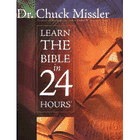
#2 - Evidence for God ed. by William Dembski and Michael Licona (Baker Publishing Group)

#1 - Why I am a Christian ed. by Norman Geisler and Paul Hoffman (Baker Publishing Group)

#10 - Rage Against God by Peter Hitchens (Zondervan)

#9 - Doctrine: What Christians Should Believe by Mark Driscoll (Crossway)

#8 - Reason for God by Tim Keller (Dutton)

#7 - Jesus: Tthe Only Way to God - Must You Hear the Gospel to be Saved? by John Piper (Baker Publishing Group)

#6 - Calvin's Commentaries (Baker Publishing Group)

#5 - Be Real by Warren Wiersbe (Cook Communications)

#4 - Has Christianity Failed You? by Ravi Zacharias (Zondervan)

#3 - Learn the Bible in 24 Hours by Chuck Missler (Thomas Nelson)

#2 - Evidence for God ed. by William Dembski and Michael Licona (Baker Publishing Group)

#1 - Why I am a Christian ed. by Norman Geisler and Paul Hoffman (Baker Publishing Group)

Monday, August 16, 2010
On the Use of Italics in Bible Translations
I’m reading a book by Joel H. Hoffman called And God Said: How Translations Conceal the Bible’s Original Meaning. Hoffman holds a Ph.D. in linguistics and has served on the faculties of Brandeis University and Hebrew Union College. One of the issues he discusses is the use of italics in translations to indicate words that are not in the original text. This is not a common feature in modern translations but was very common, and inconsistently used, in the King James Version. His discussion is very good. (Incidentally, the Geneva Bible was the first Bible to use italics.)
And God Said is a hardcover from Thomas Dunne Books with 256 pages and sells for $25.99. Walter Brueggemann says this of Hoffman's work

“Linguists know that there are two kinds of languages. One kind, like English, almost always requires a subject. When the subject is the one doing the verb, as in ‘God said,’ every language includes a subject. But the question arises of what happens when on one or nothing in particular is the one doing the verb. The answer is that, in languages such as English that required a subject, a pleonastic subject serves as the subject of the sentence. In English, the pleonastic subject is usually the word ‘it’ or ‘there.’
The clearest example in English is ‘It is raining.’ The ‘it’ is not ‘raining.’ Rather, the pleonastic ‘it’ is included in English only because English always requires a subject. Similarly, we see a pleonastic ‘there’ in ‘There is no reason to panic.’
French, which behaves like English, similarly requires a subject even when the subject isn’t doing the verb. ‘It’s raining’ in French is il pleut. Il—a pleonastic subject here—means ‘it’ or (‘he’), and pleut means ‘rain.’
Other languages do not require a subject. Spanish is such a language. Accordingly, the Spanish equivalent of ‘It’s raining’ or il pleut is the one word llueve—literally, ‘rains.’
How should llueve be translated into English? Obviously, the only reasonable answer is ‘It’s raining.’ Italicizing the ‘it’s,’ or marking in some other way the difference between English and Spanish grammar, would do only that: mark a difference in grammar. It would not make the translation more accurate or in any other way better.
Hebrew is like Spanish. It does not require a subject. That’s why ‘There will-be light’ in Hebrew (y’hi or) doesn’t have a word for ‘there’ and literally ends up ‘will-be light.’
The KJV gets this right and, perhaps surprisingly in light of Genesis 1:4, does not italicize anything in Genesis 1:3, offering as a translation the fairly accurate ‘And God said, Let there be light: and there was light.’
Unfortunately, in the very next line, the word ‘it’ is italicized: ‘And God saw the light, that it was good. . . .’ Like ‘there’ in the previous line, there is nothing unusual about ‘it’ (or ‘was,’ for that matter). There is nothing missing in the Hebrew. There is nothing extra in the English. And italicizing ‘it’ leaves the English reader with the mistaken impression that the ‘it’ is somehow less a part of the original than other words.
From the point of view of studying Hebrew grammar, there might be some merit to that claim. The italicized ‘it’ might remind students of Hebrew that Hebrew doesn’t require pleonastic subjects, whereas English does. But from the point of view of translation, it’s simply a mistake. It leaves the English reader not with a better understanding of the original but with a misunderstanding of the original.” (73-74)I'll give another example later this week.
And God Said is a hardcover from Thomas Dunne Books with 256 pages and sells for $25.99. Walter Brueggemann says this of Hoffman's work
"Hoffman is wise and gentle as he exhibits the issue of distortion by way of translation. Short of all readers learning Hebrew, Hoffman's work is the best gift for a careful reader of a text that defies easy contemporary rendering."

Sunday, August 15, 2010
Be Still and Know That I Am God - What Does it Really Mean?
For as long as I can remember I've heard this verse cited with the encouragement that God is telling us to be still and make ourselves aware of who he really is. In that time of "stillness" we will experience God in ways that could not be done apart from being still. I came across this again in something I read recently so I thought I would look up what John Goldingay had to say in his commentary on the Psalms in the Baker Commentary on the Old Testament Wisdom and Psalms. I found part of it surprising and part of it alarming. I put in italics what surprised me and in bold what alarmed me.

"'Be still and know that I am God' is a common invitation in Christian spirituality. This involves a reinterpretation of the psalm. Nowhere do the psalms have an ideal of silence. Their assumption is that one finds God not in silence but in noise. In noisy Western cultures, we may need to cultivate silence, and the use of the psalm to this end may be inspired by the Holy Spirit, even though it does make the words mean something that the psalmist did not say and would not have dreamed of saying. Spirit-inspired interpretation often works by making the words of Scripture mean something quite different from what they actually meant, because new situations make it necessary for God to say new things. At the same time, we have to be wary of missing what the text actually did say. Here it issues an important challenge to the superpower to stand still and recognize that God is God and that the superpower is not." (vol. 2, p. 73)I was surprised, though not terribly so, to see that the verse taken from its context had acquired a life of its own and had taken on meanings not found in the text. But then Goldingay goes on to offer a justification for this very practice. As it turns out "spirit-inspired interpretation" can make "the words of Scripture mean something quite different from what they actually meant." Now he is not writing a book on hermeneutics so I understand him not going into much detail on this point but this seems to open a pandora's box for subjective interpretations under the guise of "spirit-inspired interpretation." I appreciate his caution that we should "be wary of missing what the text actually did say" but couldn't some one say "What does it matter what it originally said since I have a spirit-inspired interpretation that is not confined to the original meaning?" At the end of the day what is there to be wary of? I suppose if you're trying to say what it originally meant then the caution is applicable but with that out of the way the door is open to just about any thing that fits my fancy since a new situation may be making it necessary for God to say something new.

Saturday, August 14, 2010
When the Church is All About You
This may be a parody but there is probably a little bit of truth in it for some churches.
Thursday, August 12, 2010
Small Group Workshop - Reflections
Today was our small group workshop and I was very happy with it. We had a little over twenty people attend and they took copious notes which is always good to see. Andrew Rogers presented materials from Zondervan and I highlighted some others from various other publishers. The one that seemed to draw the most attention was a forthcoming Zondervan book by John Dickson called Life of Jesus. Andrew gave me an advanced reading copy and I started it tonight--it is simply amazing what a great writer Dickson is. The preface (it's not titled that but it comes before chapter one) is entitled "The Way We Believe (or What I Learnt from Aristotle)." He explains that over a millennia ago Aristotle wrote about how people form their beliefs. It is basically a combination of three factors: logos (the intellectual dimension), pathos (the personal or emotional dimension) and ethos (the social dimension). He explains that no one "embraces faith in Jesus Christ based solely on factual evidence." Rather when Christians tell how they became a Christian "they will often mention an intellectual component, a personal component and a social component." (13) On the other hand, he is fascinated in "the way sceptics of religion will not admit that they are sceptics for the same combination of reasons. Instead, they claim to resist Christianity for logical reasons only." But with some gentle probing he finds they usually admit that it is more complex than first acknowledged.
But, back to the workshop. One question that came up consistently was the level of "homework" that a particular study guide might have. One lady commented that she was having a hard time motivating the group to complete the homework while another said her group thrived on it. The question is an important one and studies can vary significantly from no homework at all to work to do every day of the week. We provide a packet which features many of the study guides we talk about and many more (this year's packet featured more than 40 different study guides). Next year I'm going to add a category stating the level of homework involved: none, light, moderate or heavy. I think this will be a valuable addition to the information packet.
The attendees provided some very kind comments and seemed genuinely appreciative of our efforts. That makes all the work worth it to know it is helping. I'm taking the workshop "on the road" for a couple of churches who could not attend but asked if we could come and do a short presentation in their church. We've done this in the past and are happy to accommodate the needs of these churches. If your church would like us to come and do a presentation give us a call and we'll work out the details. We do ask that a minimum of ten people can attend. The phone number to the store is 616-957-3110 or toll free 866-241-6733.
Thanks to all of you who were able to come out. May God richly bless your studies in the coming year. Till next year! Here's the cover for Dickson's new book. It will be a paperback with 208 pages and sell for $12.99. A DVD will also be available which will sell for $19.99.

"An event in the past called into question the fairness or existence of the Almighty. A Christian they once knew turned out to be an ugly hypocrite and it spoiled their appreciation of anything coming out of the mouth of believers. Personal and social factors prove important for unbelief, after all."Dickson then explains that he will lay out some
"robust arguments for the life and significance of Jesus, but I have no intention of hiding the fact that some of what follows appeals to the personal and social dimensions of our lives. After all, if there is a God, surely he would expect his truth not only to be factually verifiable but also personally satisfying and socially relevant." (14)Dickson is fresh, very easy to read and imminently reasonable. He writes with the precision of a philosopher and the heart of a pastor. You can read the first chapter, "The God-Question," here.
But, back to the workshop. One question that came up consistently was the level of "homework" that a particular study guide might have. One lady commented that she was having a hard time motivating the group to complete the homework while another said her group thrived on it. The question is an important one and studies can vary significantly from no homework at all to work to do every day of the week. We provide a packet which features many of the study guides we talk about and many more (this year's packet featured more than 40 different study guides). Next year I'm going to add a category stating the level of homework involved: none, light, moderate or heavy. I think this will be a valuable addition to the information packet.
The attendees provided some very kind comments and seemed genuinely appreciative of our efforts. That makes all the work worth it to know it is helping. I'm taking the workshop "on the road" for a couple of churches who could not attend but asked if we could come and do a short presentation in their church. We've done this in the past and are happy to accommodate the needs of these churches. If your church would like us to come and do a presentation give us a call and we'll work out the details. We do ask that a minimum of ten people can attend. The phone number to the store is 616-957-3110 or toll free 866-241-6733.
Thanks to all of you who were able to come out. May God richly bless your studies in the coming year. Till next year! Here's the cover for Dickson's new book. It will be a paperback with 208 pages and sell for $12.99. A DVD will also be available which will sell for $19.99.

Wednesday, August 11, 2010
Small Group Workshop Tomorrow
Here's a final reminder that our Small Group Workshop will be tomorrow in the store at 10:00 a.m. If your a small group leader, member of a small group or are looking for that next study guide to do on your own this could be just what your looking for. We have prepared a packet featuring over 30 of the newest study guides that have come out in the past year and some that are forthcoming. We will cover some of those in more detail during the workshop. Andrew Rogers from Zondervan has generously offered some of his time to show us some exciting new product. I will discuss about six or so other items and then we will open it for questions. Special discounts will be available and we're giving away some great door prizes. It will only go about an hour so it won't take too much out of your busy day. I look forward to seeing you there!
Subscribe to:
Posts (Atom)